
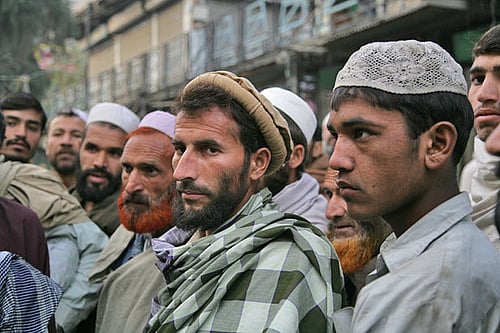
It's the first cold day of the winter, and Nasaji Bagrami camp on the outskirts of Kabul is humming with the presence of a welcome visitor. Scores of men have formed an unruly crescent around a truck brimming with coal. Two years ago, more than twenty children died due to the harsh winter weather at this camp for internally displaced people (IDPs), and also the larger camp in Charahi Qambar. To prevent this from happening again, a few of us have pooled money to purchase a sack of coal for each family. At 660 Afghanis (USD 11) a bag, coal is an unthinkable luxury here. We have come to oversee the unloading of the sacks, to make sure every family gets their share.
In a nearby vacant lot children use shoes as pretend racecars, gliding them through the hand-dug tracks in the mud. A boy of four or five runs around with his bottom exposed, unaffected by the December chill that has me drawing my headscarf tighter around my neck. Those old enough to know that coal will beget warmth busy themselves by picking up the black specks that have fallen from the truck. They fight over them, the way children elsewhere might fight over boiled sweets.
Over 350 families live in destitution and squalor at Bagrami, oilcans beaten flat serving as doors so small that only the malnourished could pass through. Everything else here, from the dun-coloured mud huts to the newborns, seems like an ersatz version of the real thing. The camp elder is Wali Khan, who tells me that his clan moved here from the southern province of Helmand, where fighting had been the hardest. Most of the men claim to have been sharecroppers, growing wheat and corn. A UNHCR officer will later tell me that many had in fact been poppy farmers, driven out of their homes by eradication campaigns. Khan says they decided to head north when the airstrike made lives there unbearable. Like others among the thousands of internally displaced who have arrived in Kabul since 2001, Khan and his men had hoped for luck in the relative affluence of the capital. Since the NATO invasion in 2001, the US had spent as much as USD 100 billion in non-military aid, according to one estimate. Surely, there would be enough wealth to go around for everyone, the Helmandi sharecroppers reasoned. Instead, what greeted them when they arrived in Kabul was a war bubble on the cusp of bursting.
When they arrived in 2009, Kabul was already a city hostile to newcomers. Donor fatigue had begun to settle in, which meant that the few aid agencies working to help IDPs were scaling back their operations. Most of the empty spaces in the city had been filled by those who had come before them. Khan and his clan couldn't find even a sliver of the city that was willing to accommodate them. After some wandering, they settled on a small stretch of barren land that had gone unclaimed. They dug holes, and with the fresh earth they built crude walls that would protect them from the elements. The better-off fastened tarpaulins as roofs. The rest made a patchwork out of plastic sheets. On the day I visit, heaps of trash are everywhere, as are children playing in them. In one house, I nearly step on a bundle on the floor before realising it is an infant. Cubicles that have been built into mud walls contain the few earthly possessions they have: a corner of stale bread, a single green pepper, a comb with most of its teeth missing, two stones used to wash clothes. There are no words for this kind of poverty.