
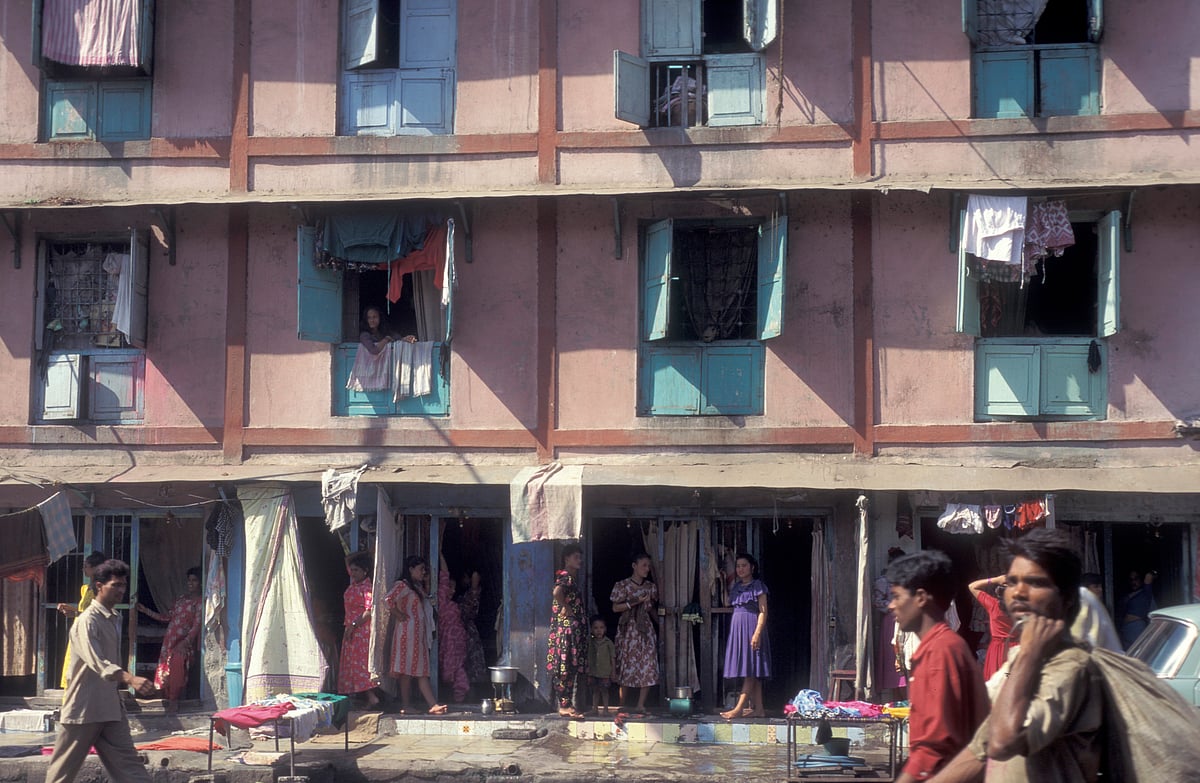
Compared with its size and status in years passed, one can notice many changes upon revisiting Kamathipura in Mumbai today. It remains the most famous red-light district in India, and was once considered the largest in Asia. The name itself was part of Bollywood's lexicon from the very beginning of the Bombay film industry, and was synonymous with prostitution, fallen women and lost honour. Yet the epic, iconic representation of Kamathipura belies the mundane nature of the everyday life that also exists there – with tailoring shops, tea stalls and restaurants crowded cheek by jowl with the century-old chawls, where people who sell sex live with their families. The legal regime that governs their daily lives, meanwhile, continues to feed off of long-held, and often unexamined, ideas about why and how people there engage in this work, and about what their existence means for the wider world.
Even as the law remains moored in the past, today the daily routines of the women, in particular, who live and work in Kamathipura are overlaid with a sense that things are changing. Recent years have seen an increase in the number of police raids on brothels, with fewer clients visiting sex workers in the area, and the ones who do having generally less money to spend. Such changes could speed up massively in the near future, as multiple 'redevelopment' schemes go forward, threatening to pave over one of Mumbai's most infamous and historic areas in favour of luxury apartments, a shopping mall, or both. Importantly, the vast changes in this area are directly linked with the wealth that neoliberalism has brought to the new Indian upper class. What may be happening here has already happened to historic red-light districts in several urban areas elsewhere in India, the US and Europe, and is part of a global urban trend. In order to understand this trend with respect to Kamathipura, it is also necessary to examine the relationships between the internationalised anti-trafficking policy framework, migration and sexual commerce.
Over the past ten years, media-driven punditry about India being poised to become the next economic superpower has been accompanied by frustration in some international circles over the Indian government's continued 'laxity' in controlling what is referred to as 'human trafficking'. In this argument, 'human trafficking' is equated with prostitution, and with female prostitution in particular, and the only proper response is framed in terms of criminalising all sexual commerce. In fact, there is significant disagreement about what the legal definition of 'human trafficking' should encompass, particularly regarding the question of whether selling sexual services is inherently equivalent to human trafficking. This disagreement is both about whether prostitution should or should not be understood as trafficking per se, and about the utility of the anti-trafficking framework itself.
Critics of the framework argue that conflating trafficking and prostitution renders all sex workers as victims, rationalises a fairly heavy-handed response to prostitution by the state, and ignores the economic and social contexts for sex work. The ideas that some sex workers might be negotiating their livelihoods among a limited set of options, or that others might decide that prostitution is the best of a vast range of options, are precluded by only understanding prostitution in terms of trafficking. This telescoped understanding of trafficking – one that narrows its focus to sexual commerce and magnifies prostitution – has also tended to miss human trafficking into other industries, although the official definition of trafficking, enshrined in the Palermo Protocol, does gesture in this direction.