
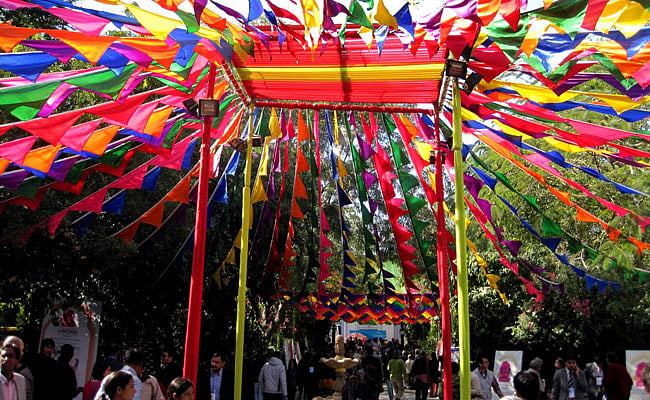
Why did tens of thousands of people flock to the Diggi Palace in Jaipur on the morning of 22 January 2012? Why did hundreds of men mob the same venue on the afternoon of 24 January 2012? And who were the others, milling in the shadows, trying to catch each other's attention?
Diggi Palace has been hosting the DSC Jaipur Literature Festival for five years now, but this year's program attracted more attention than in any of the years past. The Indian press seemed to have finally awoken to the magnitude and significance of the festival, but the focus of each section of the press was on wildly different facets of the festival: some questioned the very utility of literature festivals, while others focused on the nature of – and need for – freedom of expression and censorship in India. God made his presence felt, and atheists threw insults at him. The local press, as in past years, published pictures of smartly dressed women smoking cigarettes and drinking wine, enthralled by the opportunity to witness at close quarters evidence of supposed moral decay.
The programme sheet for the festival said that the festival had been able to create a democratic space where authors, politicians, film stars and the audience mix together as equals. Into this mix was thrown Oprah Winfrey, ostensibly a film star herself, and, through her book club, a most influential promoter of literature. But, she didn't mix democratically. Instead, her presence at the festival brought hundreds of additional policemen to shoo away thousands of people who came as pilgrims to the shrine of celebrity. Pakistan, Jerusalem, and the literature of protest were being discussed in parallel sessions, but the press only picked up on Oprah, in a sari, smarming about the beauty of India and the good sense in arranged marriages. The press, the police, and the politicians even forgot Rushdie for the day.
Rushdie's part in the absurdist play of politics around this year's Jaipur Literature Festival has been much discussed, and most of the political, religious and intellectual backlash on the festival has been focused on him, his absence and his presence. More so than god, Rushdie seemed omnipresent and omnipotent: capable of stirring discord, manifesting himself in every session regardless of the purported topic of discussion, capable of speaking from beyond the seas. Even so, there were probably more people turned away after queuing for hours to see Oprah than there were on either side of the debate surrounding Rushdie and freedom of expression in India. On one hand was the grave struggle for an individual's right to foster doubt alongside faith, and on the other was celebrity and glitz. On the one hand was Kiran Nagarkar, a writer's writer, author of the critically acclaimed novel Cuckold, complaining about how his book hasn't sold, and on the other hand was the Bollywood masala of TV personality Yana Gupta, batting her eyelids for the cameras, talking up her dieting book How to Love Yourself and Get the Body You Love. Girish Karnad, a towering personality in the Indian theatre scene, was refused a seat by a schoolgirl waiting for her friends, while Chetan Bhagat, bestselling author of forgettable fare, was being mobbed by schoolgirls filling up scented notebooks with celebrity autographs. Glitz often triumphed over gravity.