
On 17 January 2003, Nepal's government lifted a five-year-old ban on Nepali women going to Persian gulf countries to work following a supreme court ruling that the ban violated the women's human rights. The ban was imposed in 1998 to 'safeguard' Nepali women from the perils of domestic work in Islamic countries, where there have been some highly publicised instances of the physical and sexual abuse of foreign maids, even though women were a source of valuable remittances – approximately USD 450 million, or 50 percent of all foreign exchange earnings, 13 percent of Nepal's GDP. The gulf countries were deemed unsafe as women there 'have few rights anyway', and where Nepali women, locked behind the high walls of wealthy Arab households and speaking no Arabic, have little recourse to social support networks. For employment agencies, individual women and activists, the rights argument was the legal expression of what is, for most of the millions of domestic workers in Nepal and elsewhere, a decision driven fundamentally by economic concerns.
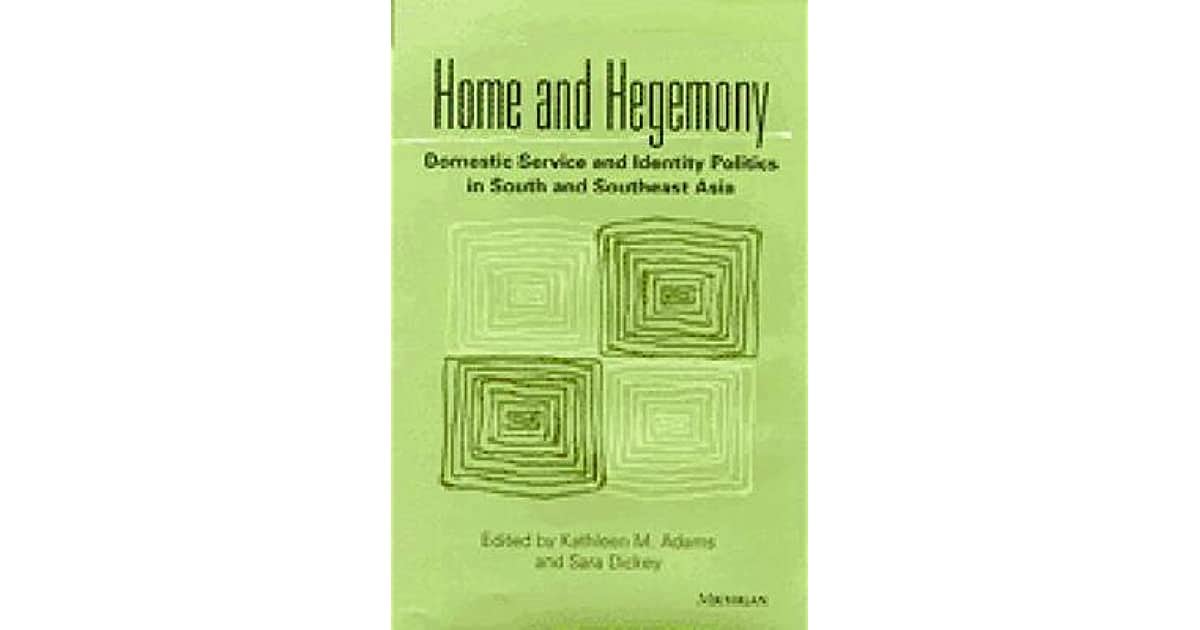
Home and Hegemony: Domestic Service and Identity Politics in South and Southeast Asia presents ethnographic sketches of domestic service in south India, Nepal, the Philippines, Hong Kong, Sri Lanka, and Java and Sulawesi in Indonesia. Although the editors, Kathleen M Adams and Sara Dickey, accept that it is impossible to estimate the numbers engaged in domestic service because of the unorganised nature of such employment, and because migrant domestic workers are often unregistered, they cite studies to assert that far from decreasing with the spreading use of time- and labour-saving technologies, as was widely assumed would happen, the number of domestic workers and people who employ them is only going up.
There are two types of essays in Home and Hegemony – those that focus on domestic workers employed in their own country, and those that deal with migrant domestic workers. Dickey writes about how workers and employers, when talking about each other in Madurai, Tamil Nadu, south India, construct different identities with reference to class, character, and the luxury of choice as opposed to necessity. Rachel Tolen's essay deals with the rather fashionable cultural studies subject of the contestation surrounding the transfer of class-based knowledge, such as the ability to speak English, in the context of the rather cosmopolitan railway colony in Madras where the servants are close to being government employees, but are not quite. Saubhagya Shah writes about the construction of class and urban-rural identities, focusing on the fictive kinship and schooling that children who move from Nepal's hinterland to be live-in servants in Kathmandu experience. Jean-Paul Dumont also focuses on language, examining the use of the terms 'domestic workers', 'helper' and 'nursemaid' in the Philippines, the deep meanings they convey and their transitory nature. GG Weix also writes about fictive kinship, and "betwixt and between" identities in Java where domestics are adopted into their masters' homes. In particular, she delineates how the logic of gift-giving regularly and ritually sabotages the illusions of family bonds. Editor Adams discusses the role of humour, especially joking references to kinship terms, in maintaining and subverting hierarchies in homes with long-term live-in domestics.
Four essays deal with a different kind of domestic service. Michele Gamburd analyses how the contested changes in ideas about motherhood, gendered divisions of labour, and personal identity are played out when Sri Lankan women migrate to be nannies and housemaids in West Asia 'for the sake of their own children'. Louise Kidder's contribution discusses how relations between British expatriates in Bangalore and their Indian domestic workers show that hierarchies of skill, knowledge and dependence can be not quite linear – expats may have the money, but they cannot function without the skills and local knowledge of their employees. Nicole Constable presents the case of domestic workers from all parts of the Philippines who in Hong Kong, as much in response to local stereotypes about them as exhortations from their own government to be 'model workers', start to articulate a single Filipina identity. Constable illustrates how the official as well as defensive 'Filipina' identity is regularly complicated by differences in class and sexuality. Kathryn Robinson analyses the position of Indonesian women. They were initially encouraged to work in Saudi Arabia because it is also 'Islamic', but incidents of abuse led to a long-drawn debate on whether it is acceptable for Indonesian Muslim women to work overseas, as well as to a diplomatic impasse between the two countries. Robinson demonstrates that while gender, religion, and the 'new order' Indonesian rhetoric of the 'family principle' constructed a national identity that appeared to provide opportunity, when these same principles were deployed to manage economic and diplomatic relations, the results for women were often less than progressive.