
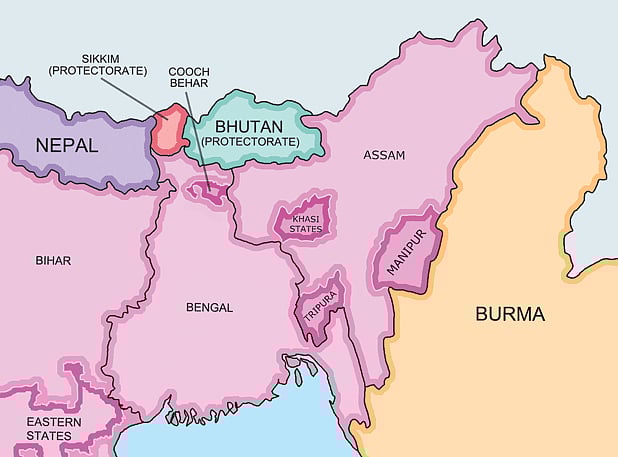
Assam is today a state of India and, as such, an official region of a world entirely covered by nations and encompassed by national maps. We have no choice but to locate any region like Assam inside of national geography, for this both controls our spatial imagination and conveys a specific location, identity and meaning.
But other perspectives do exist. Despite the seemingly universal authority of national geography, the location of social reality is flexible. That Assam is part of India is indisputable; but it is important to note that this fact coexists with others that find different 'locations' for Assam. Indeed, looking at any area's geography in slightly less conventional ways allows for the appearance of a kaleidoscope of social realities. Such an understanding allows for important new frames of reference for scholarship, activism and policy-making.
The first step is to appreciate the political nature of all modern maps. Territorial boundaries – as well as social efforts to define, enforce and reshape them – represent political projects rather than simple facts. The makers and enforcers of boundaries use maps today to define human reality inside of national territory. As a result, everything in the world has acquired a national identity. We see the boundaries of national states so often that they almost appear to be natural features of the globe.
This virtual reality came into being only in the 19th century, as various technologies for surveying the earth, mass-printing, mass-education and other innovations began to make viewing standardised maps a common experience. Making maps, reading maps, talking about maps, and thinking with mental maps became increasingly common with each passing decade. By the 1950s, people around the world had substantial map-knowledge in common. Today, we can reasonably imagine that most people in the world share common map-knowledge because they routinely experience various versions of exactly the same maps. During the global expansion of modern mapping, national territory suddenly incorporated all of the earth's geography. Though national boundaries only covered the entire globe after 1950, within a decade or two all histories of all peoples in the world came to appear inside national maps, in a cookie-cutter world of national geography. This has been the most comprehensive organisation of spatial experience in human history. Spaces that elude national maps have now mostly disappeared from intellectual life.