
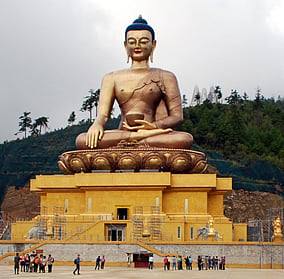
In a compound in a clearing on a hill, about ten minutes drive out of Thimphu, sits a newly-built and imposing statue of the Buddha. Though sealed off at night the spot still attracts cars packed with youngsters once the revelry in town gets over; the view down over the scattered lights of the valley is spectacular and there are no neighbours to complain about the noise. The Buddha Dordenma is 51.5 metres tall, made of gold and bronze, and filled with over 125,000 miniature replicas. Despite the universal Buddhist aspirations, the statue is primarily a domestic symbol, embodying both Bhutan's image as a spiritual idyll and its own aspirations to serving as the ground for better ways of living and governing.
Back down in the city at 9 am, small groups of college graduates dressed in smart kira and gho cluster in front of the main gate at the Ministry of Labour and Human Resources. Inside, portraits of the royal couple look down over the bureaucrats who control one of the gateways into the elite cadre tasked with negotiating Bhutan's cautious path to 'modernity'. Abroad, this path is represented by a collage of spirituality, the concept of Gross National Happiness (GNH) and the most photogenic Himalayan royals since Hope Cooke and Palden Thondup Namgyal of Sikkim. At home, a far less exciting fixation with bureaucracy and civic life, fuelled by decades of aid and support from India and other foreign donors, has taken root. The famous experiments with happiness are taking place in what is probably the most bureaucratised corner of Southasia.
The civil service is "almost saturated," according to an employment guide published in 2015 by the Ministry of Labour and Human Resources. It remains, however, the most popular route to the bright lights of Thimphu for an educated and young workforce that has less and less interest in working the land. In the capital, one in eight inhabitants is a civil servant. There are also spellcheckers for the city's commercial signboards but few other attractive employment options are available outside of the government. "Bhutan's primary goal today is to achieve self-reliance," wrote H N Misra, an Indian academic who visited in the late 1980s to collect data on its economy and national planning. The deluge of foreign aid has made achieving this self-reliance unnecessary, and allowed generations of young Bhutanese to aspire to the white-collar jobs of planning and governing the nation, while foreign workers (generally from the Indian states near Bhutan) build most of its infrastructure. As recently as 2010, almost 50 percent of graduate applicants from Sherubste College, the largest in the Royal University of Bhutan, were making it through the 'General Category' entrance exam (taken by the majority of applicants) for the civil service.
Exporting hydropower to India has offset some of the costs of this civic bonanza. A recent lull in new projects coming online however, is raising old concerns at how much Bhutan's economy relies on its dams. (Bhutan has accrued the worst debt to GDP ratio in Southasia, in large part thanks to the high costs of building these dams). A youth unemployment problem that refuses to go away, and a private sector still struggling to make a meaningful contribution to economic growth are other symptoms of the modern Bhutanese state's obsession with itself, which is beginning to cause concern. A recent editorial in the Kuensel newspaper criticised the secretive way in which bureaucrats conducted the mid-term review last March. "Planners, policymakers and politicians are holding back what needs to come out in public for the benefit of the people," read the editorial, which went on to demand that ordinary citizens be "pulled into the circle."