
Some years ago, a friend from Calcutta, a veteran journalist who had covered the Gorkhaland agitations of the 1980s, had this to say about the relationship between the Gorkha National Liberation Front leader, Subhas Ghisingh, and the West Bengal government: "Jyoti Basu has given Ghisingh a long rope, so that he can hang himself." Two and a half decades later, the brand-new political party in Darjeeling, the Gorkha Janmukti Morcha (GJMM), which has taken it upon itself to "give a new direction to the politics of Darjeeling", vouches that the rope in question was handed over to Ghisingh not to hang himself, but to bundle up the entire Gorkha community and roll it down the Teesta. Working hand in glove with the West Bengal government, elections to the Darjeeling Gorkha Hill Council (DGHC) were repeatedly deferred, extending Ghisingh's term as the sole administrative caretaker of the Council more than six times between March 2004 and March 2008.
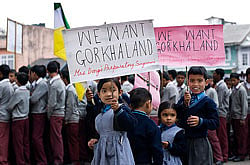
The hills of Darjeeling are now preparing for the second Gorkhaland uprising, which the new leader, Bimal Gurung, has promised will be a "fight to the finish". Battle lines have been drawn, as have the boundary lines of the prospective state of Gorkhaland. Demarcating the area of the proposed separate state, Morcha supporters have marched across the hills of Darjeeling and the plains of the Doars, garnering support and planting Morcha flags from the Mechi River in the west to the Sankosh in the east. Gurung has even gone so far as to prophesise that statehood would be attained by March 2010.
Claiming to have drawn inspiration from Mohandas K Gandhi's Satyagraha movement, Gurung has maintained that, this time round, the movement would be a "democratic one". An indefinite bandh was called in the Darjeeling Hills in late June, for the third time in the last four months. Two of these were to protest police atrocities against GJMM supporters (including students and ex-soldiers who had gathered for a peace rally in Siliguri), and one took place when the party was pressuring the state to make Ghisingh step down as caretaker administrator. The movement has been met with incredible resistance by the state government, leading to accusation of 'high-handedness' from several opposition leaders of West Bengal.
The crackdown comes against a backdrop of apprehensions in Calcutta about the ramifications of conceding a new state of Gorkhaland. The authorities have expressed fears that allowing such a step could ignite violence between the Bengalis in the plains and the Nepalis in the Darjeeling Hills. This fear, of course, proved unfounded in May, when Bimal Gurung held a public meeting in the outskirts Siliguri that a record 200,000 people attended. Rather, the state's fear seems closer to the prospect of having Adivasis and Rajbangshis of the tea belt of the Doars rising up simultaneously. The Kamptapuri Progressive Party (KPP), for instance, has long demanded a separate state of Kamptapur. This community has remained a deprived lot, both in terms of economy and political representation, despite being the original inhabitants of the area.