
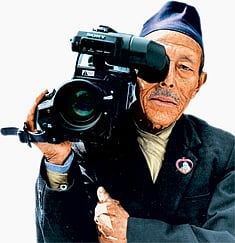
Prashant Tamang, we know, is the West Bengali, Nepali-speaking citizen of India who made it right to the top of the Indian Idol television tamasha. But who is the 'Tamang' in him? What is the trajectory that brings someone from the steep valleys of the central Himalaya to be idolised by tens of millions of people – viewers who know nothing of that trajectory?
There is a story that goes back beyond the arrival of what are known as the Tamangs' into the central Himalaya – a time and place without history, but with some folklore and conjecture. Some say that this migration began from the lakes that lie to the south of what is today Mongolia, some thousand or two thousand years ago. This movement of people headed south and then westward, along the northern slopes of the Himalaya. One group penetrated the steep valleys north of the Kathmandu Valley, where its members evolved to become – as they are identified in the Nepal Census – Tamang. Other groups, who came earlier or later, also penetrated the Himalayan ramparts, but in different areas. They became the different tribes of what two and a half centuries ago became the state of Nepal.
The Tamang, translated by some to refer to an equestrian people, came to surround Kathmandu as the valley evolved a high urban culture that rivalled some of the finest in Asia. But the Tamang were not to benefit from this evolution. Their proximity to the thriving mini-kingdoms of Kathmandu, made rich by paddy cultivation and entrepot trade, led them to be bonded in support of the growth of the Valley civilisation.
And so, the Tamangs, by the virtue of their location, became exploited. these included the slightly variegated Tamang communities surrounding the Kathmandu Valley, in Rasuwa to the northwest, Sindhu Palchok to the northeast, Kavre and Ramechap to the east, Lalitpur and Makwanpur to the south and southwest, and Dhading to the west.