
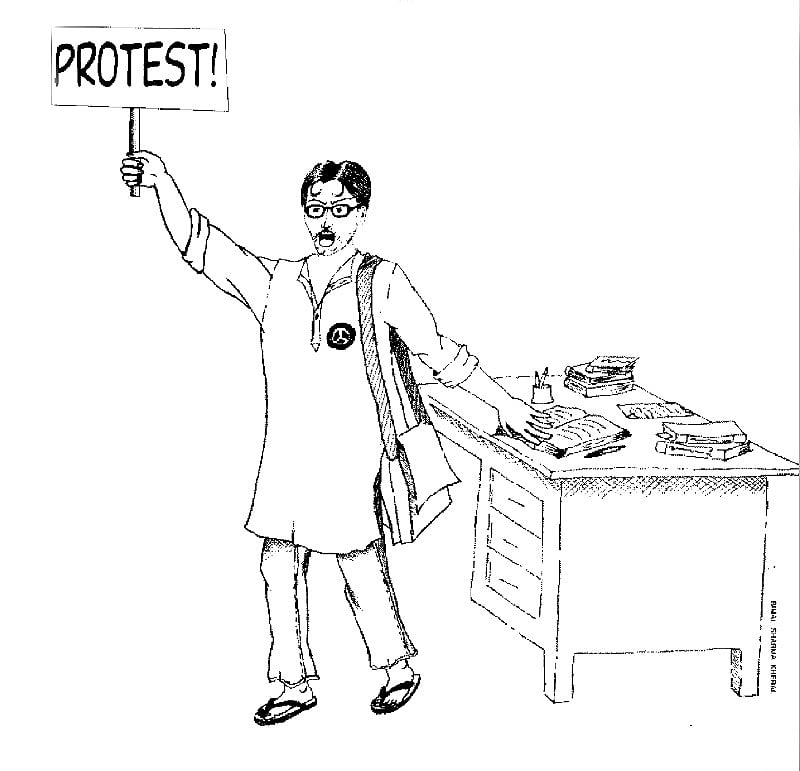
HIMAL MEDIOCRITY SERIES – I
There is a well-known Southasian social scientist, a particular favourite of the editor of Himal, who describes himself on the jacket of a book as active in the environmental, human rights, alternative science and peace movements. Now I cannot say about the other three, but if this worthy is active in the environmental movement, then my name is Medha Patkar.
Exaggerated claims to a personal radicalism are the staple of Southasian social science, made with carefree abandon by man and woman, young and old, Nepali, Pakistani, Sri Lankan, Indian, Bangladeshi and (I dare say) Maldivian. It was once all right to label a piece of work in descriptive terms, that is, to label a study of land relations in eastern Nepal as, precisely, A Study of Land Relations in Eastern Nepal. Now it would be presented as An Action-Research Project or Programme of Participatory Intervention, written by an activist intellectual or intellectual activist.
Why have these claims become necessary? First, to elevate the author, to dignify him or her with a moral authority that is believed to come through association, however tenuous, with a social movement or political project. Second, and simultaneously, the claim is made to intimidate readers, to coerce them into an a priori acceptance of the results of the article or book placed before them, to make certain that they ask no questions about the means by which these results have been arrived at. For how can one begin to challenge a study advertised as a critique of Western hegemony or an attempt to give voice to the voiceless? If one raises doubts about the reliability of the data or the validity of the methodology, one runs the risk of being made complicit in the projects of colonial/feudal/patriarchal domination