
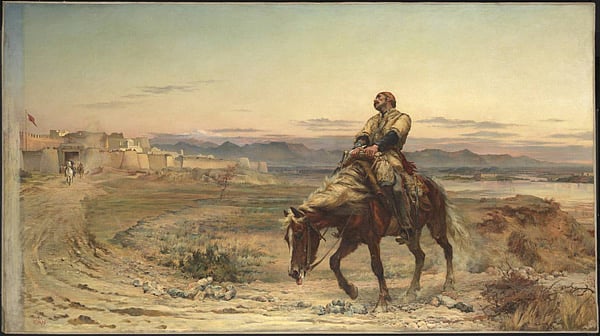
William Dalrymple's most recent book Return of a King: The Battle for Afghanistan 1839-1842, is the third of the author's major historical works that looks at the British colonialists in Southasia from a hybrid British-Southasian standpoint. It is the history of a war that the Afghans never forgot, that still lives in their collective and folk memory, but that Britain wilfully consigned to amnesia. And perhaps for good reason, from their perspective:
At the very height of the British Empire, at a point when the British controlled more of the world economy than they would ever do again, and at a time when traditional forces were everywhere being massacred by industrialised colonial armies, it was a rare moment of complete colonial humiliation.
The Great Game was at its height in 1839, and Britain was increasingly worried about the threat Russia posed to their imperial hegemony in Southasia. In response to faulty or misconstrued intelligence that Russia was taking an interest in Afghanistan, Britain invaded the latter with an army of some eighteen thousand. They deposed the ruling Amir Dost Muhammad Khan, a popular leader even in some contemporary British accounts, after he seemed to be becoming too friendly with the Russians. His defeat seemed remarkably simple. Shah Shuja, a deposed rival of Dost Muhammad's who had been exiled in India for many years, was installed by the British as a puppet ruler. Entering the country proved easy, but staying and convincing the Afghans that they had a right to be there did not. The occupation was unpopular with the Afghan people, and resistance gathered behind Dost Muhammad and his cohort.
Sporadic attacks upon Britons and their camps throughout 1840 and 1841 reached crisis point in late 1841, but leaving was not as easy as entering. In early 1842, the British negotiated for a safe retreat from their indefensible and poorly-planned cantonment on the outskirts of Kabul. While traversing mountain passes, valleys and gorges this caravan of administrators, soldiers, family and servants were repeatedly attacked by Afghan tribesmen. Those who were not killed either froze or starved to death, or were captured, sometimes to be sold as slaves. Only one man – a doctor – made it to Jalalabad, a city to the east of Kabul and near the frontier with British India. Before the British completely withdrew from Afghanistan in October 1842, they sent an 'army of retribution' to plunder and destroy Kabul in retaliation for the earlier defeat. Dost Muhammad was reinstated in Kabul and he ruled, progressively enlarging his dominions, until his death in 1863. Shah Shuja, who had continued to try to work with the British despite extreme betrayal once circumstances turned against them, had been assassinated by his godson in April 1842.