
Women's nude bodies have been central to two tumultuous events in Manipur separated by almost two decades. Home to the Imphal Valley-dwelling Meitei and the predominantly hill-dwelling Kuki-Zo and Naga tribes, Manipur has with varying intensity witnessed ethnic conflict, armed insurgency, separatist movements and militarisation ever since its merger with the Union of India in 1949. A flashpoint in 2004 and now another in 2023 have drawn global attention to Manipur's simmering cauldron of deprivation both real and perceived, its human-rights violations, ethnic hostilities, land conflicts, violence and breakdown of governance. At both times, women's bodies have been the canvas on which nationalistic projects have been etched.
However, the difference between the two events could not have been starker. In one, Meitei women dramatically disrobed in public as a powerful protest against abuses by Indian security forces; in the other, three Kuki women were stripped and paraded naked by Meitei men, and two of them were gang-raped in public, to humiliate an entire community.
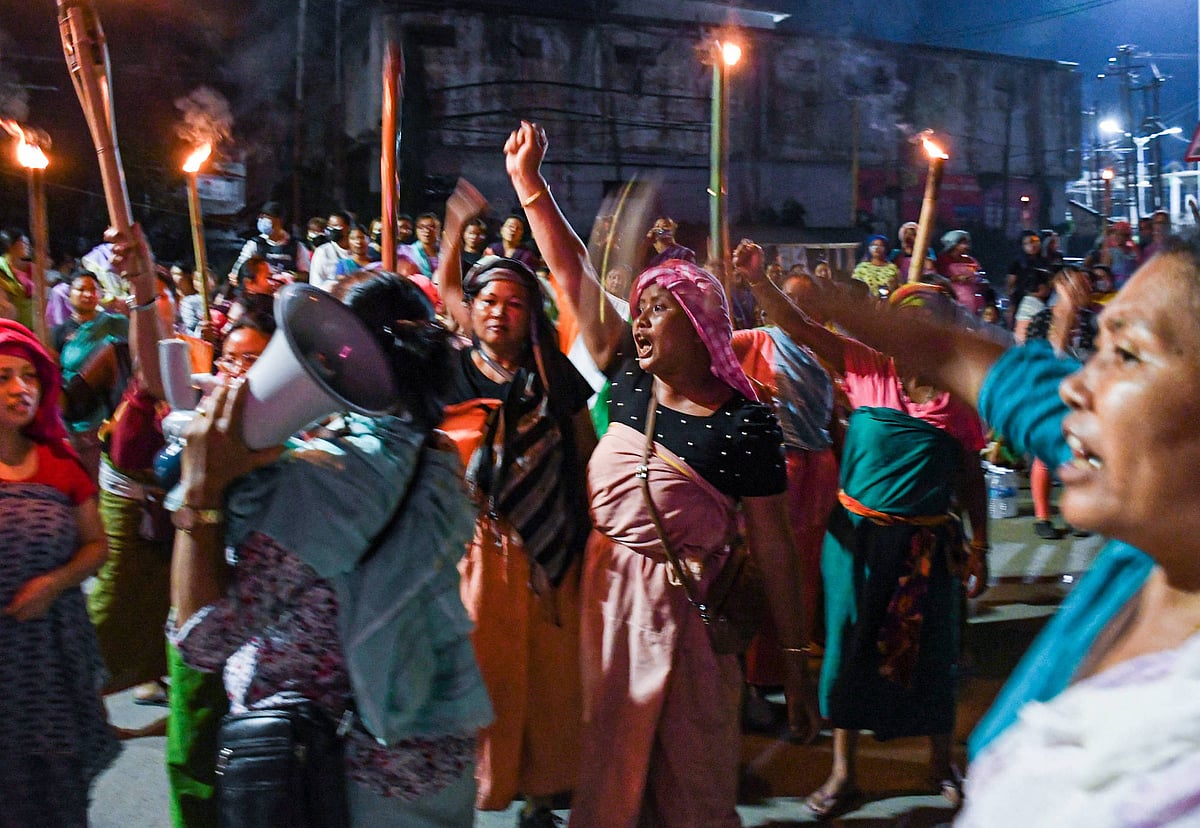
On 15 July 2004, 12 middle-aged Meitei women stripped naked in front of the Kangla Fort in the state capital of Imphal, then the headquarters of the paramilitary Assam Rifles. These women – part of the Meira Paibis, or "torch bearers", who have intervened in social problems in Manipur since the 1970s – were protesting against the rape and murder of a young woman by the security forces. "Indian Army Rape Us" screamed the banner they held aloft as they defiantly displayed their bare bodies. It was this event, which came to be known as the "naked protest", that finally drew the attention of mainstream India to this long-neglected corner of the country and set off a powerful campaign against the draconian Armed Forces (Special Powers) Act, which gives free rein to the security forces in "disturbed areas".
Fast forward to 19 July 2023, when a video surfaced of two Kuki women being paraded naked and groped by a hundreds-strong mob of Meitei men in the village of B Phainom, in Kangpokpi district to the north of Imphal. Another woman, off camera, was also stripped and paraded. Two men from the village's small group of Kuki residents were killed – the father and brother of one of the two women who was raped. The incident took place on 4 May, a day after violence erupted in Manipur following a massive protest by the hill tribes against a Manipur High Court order opening the way for the state's majority Meitei community to also gain special "tribal" status, which would allow them to claim numerous benefits currently reserved for the minority tribes. Militant groups led the widespread burning of homes and businesses in addition to murderous attacks and sexual assaults, causing eviction of Kukis from the Imphal Valley and of Meiteis from the hills. There were also numerous cases of the burning and destruction of churches, sacred to the predominantly Christian Kukis. According to an analysis by Reuters, the death toll near the end of July stood at 181 killed – a disproportionate share of them Kukis, who form roughly a sixth of Manipur's population but almost two-thirds of the dead. Other reports of violence – for instance, of Kuki youth being beheaded or bludgeoned to death – have not provoked as much outrage as the 4 May video has done. Sexual violence against women, it would seem, is far more emotive than murder.