
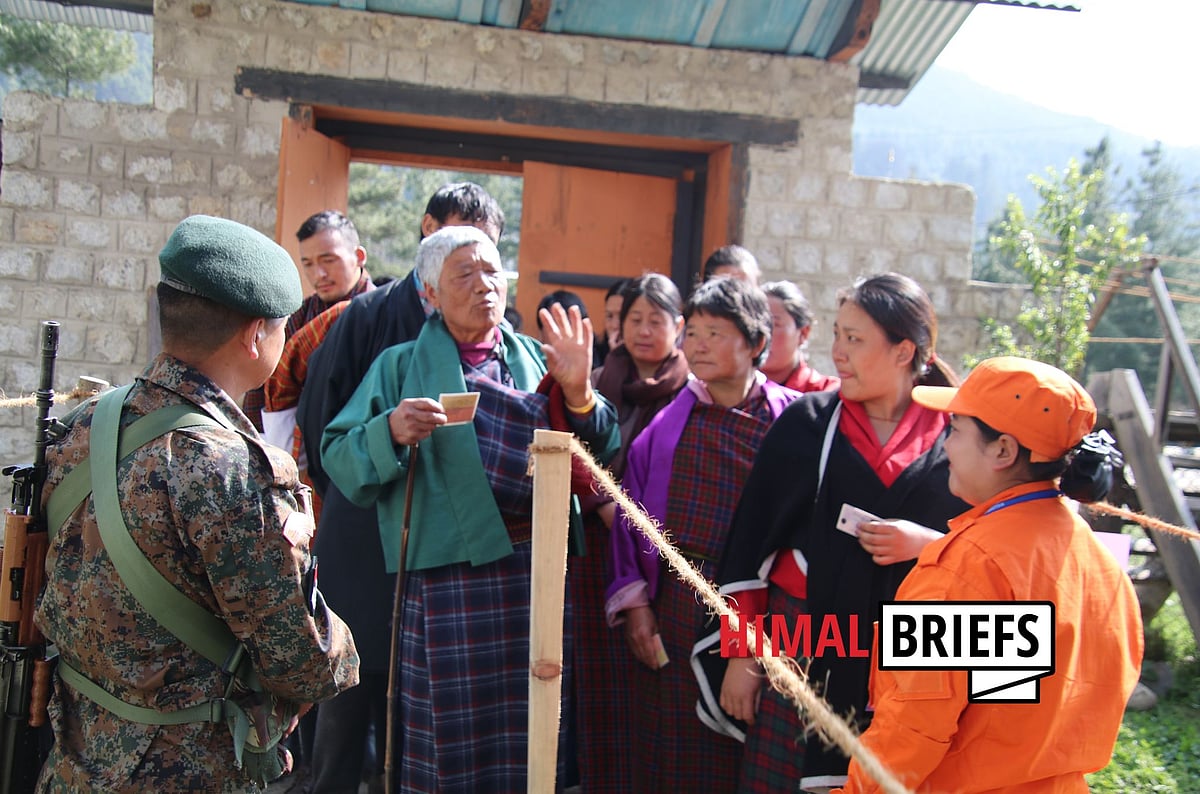
"Of course, it was also because they trusted my capability, but I have seen that the majority went by the party's popularity in the particular constituency," Norbu Wangzom, a 41-year-old former member of parliament representing Bhutan's opposition party, the Druk Phuensum Tshogpa (DPT), said. Wangzom was elected to represent the Jomotshangkha Martshala constituency, located in the south-east of Bhutan, for the second time in 2018. "As long as they like the party, they did not mind voting for a woman," she added, but they voted for her "not necessarily because they believed in a woman candidate." Regardless, Wangzom is committed to serving her constituents to the best of her ability.
Encouraged by her local community, Wangzom first contested and won a seat in Bhutan's National Council elections in 2008. As a newcomer to politics, she recalled, her initial experience was quite positive. When she contested again in 2013, she lost her seat. Wangzom ran again in 2018, ultimately winning the seat back. When we spoke in February 2023, she recognised how gender plays a role in Bhutanese politics and noted that there is a disparity between how much time and importance men are given on political platforms as compared to women. "Participation is important," Wangzom emphasised, "There are challenges, but we shouldn't give up as a woman."
The National Council is the highest legislative and policy-making body in Bhutan. In the last election, in 2018, only two women were elected to the NC, with two additional women appointed by Bhutan's king. In the recent past, there has been a shift in public perception towards women in leadership positions, with Bhutanese citizens increasingly believing that women are capable of taking on leadership responsibilities. Women occupy 18 percent of leadership positions in the civil service; comprise 3.4 percent of gups, or local government leaders and command 15.3 percent of seats in the NC.
The latest NC elections were held in April 2023 and saw nominees contesting from Bhutan's 20 dzongkhags, or districts. Despite women outnumbering men in the country's population, only nine women registered to contest as candidates from a total of seven districts. Moreover, following the Dhamngoi Zomdu, or selection procedure for candidates looking to contest seats, only five women candidates made it through, as against 84 male candidates. When election results were announced, Tshering Tshomo, from Zhemgang, was the sole woman elected to the NC. It is concerning that Bhutan will only have one woman as an elected lawmaker in the NC representing a female population of around 360,000. The country now looks to the king to take the lead in appointing more women as eminent members of the NC, using his powers of nomination under Bhutan's electoral system. The NC, as the upper house of Bhutan's parliament, comprises 20 directly elected representatives, and five eminent members nominated by the king.