
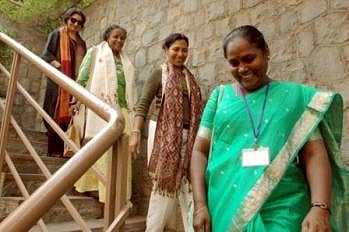
What do women writers talk about? If the South Asian Women Writers' Colloquium held in New Delhi recently is anything to go by, the answer is: everything. The subjects discussed at the 21-23 February meet included revolution and relationships, politics and pain, gender and genocide, markets and mothers, caste and creativity, language and loneliness, form and family, success and struggle, poverty and privilege, roots and rootless-ness.
The colloquium brought together over 40 writers of fiction, poetry and creative non-fiction, as well as journalism and academic writing, in at least 13 languages, from five countries of the region and farther afield. The hybrid event, dubbed "The Power of the Word," addressed concerns about literature and society, globalisation and culture, censorship and human rights. Its main aim was to explore the diverse forms of censorship faced by writers in general, and women writers in particular.
Discussions at the colloquium, organised by Women's World India, moved between the intellectual and the emotional, as writers addressed both the personal and the political. The dialogue revolved around four intersecting themes. The first, 'Writing in a time of siege', raised questions about writers' responsibility towards society, especially in times of conflict, war, displacement and dislocation. The second, 'Closing spaces in an open market', enabled participants to scrutinise the so-called openness of the apparently globalised literary market. In a third session, titled 'Exclusionary practices', writers examined the impact of caste, class, sexuality, ethnicity and other markers of difference – in addition to gender – on literary acceptability. The final session, 'The guarded tongue', highlighted the role of family, community and other affiliations in the determination of literary content.
Perhaps expectedly, religion-based identity emerged as a major issue, cutting across countries and faiths. Referring to the peculiar situation of the Muslim woman writer today, Karachi-born Kamila Shamsie highlighted the increasingly widespread "hijab or mini-skirt" syndrome, under which she herself becomes representative of something in vogue even as the context in which she is viewed is shrunk. "In the West people want to talk to me exclusively about Islam and terrorism – anything else is seen as less important … I am expected to deal with 'Muslim issues' whether or not I want to," she said. Ameena Hussein of Sri Lanka, on the other hand, pointed to the "cloud of self-censorship" hanging over her as a member of a community under siege.