
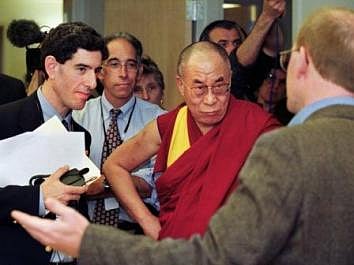
How are Tibetans to proceed with Tibet, now that the 'cause' has slowed to a crawl? The Khampa uprising of the 1960s and 1970s is but a fading memory now, ready for fictionalising films. The misty-eyed insurgents who survived are now aged and on their way out. The incredible rise of Tibetophilia in the West, underpinned by the humane spiritual politics of Tenzin Gyatso, the 14th Dalai Lama, has fed the world's need for a spiritual anchor more than it has provided political basis for bringing freedom or true autonomy to Tibet. Southasia's own governments, overawed by China's economic rise and intimidated by its reactive insularity, prefer not to rile the dragon.
The government-in-exile in Dharamsala has gone more than halfway to meet Beijing. There have been several rounds of talks between the two, which indicate that the latter at least recognises the Tibet issue as a political issue, whatever its harsh propoganda. But there has been nothing more forthcoming from Beijing over the half-decade that the talks have been held. Beijing seeks to overwhelm the Tibet question through the sheer weight of its power and certitude. One would wish it were otherwise, but it seems that the future of Tibet is hostage to the slow pace of democratisation within China. Those who had hoped that the Chinese economic boom of the 1990s would lead to magnanimity on, say, the identity demands of Xinjiang or Tibet, have come to realise that such magnanimity will be a long time coming. Or, alternatively, it will come all of a sudden, in a way that cannot be planned.
It was such considerations that led the Dalai Lama to propose what came to be known as the 'Middle Way' approach, which was eventually formally adopted in 1988. This was hardly a 'splittist' suggestion, but rather a sagacious attempt to seek autonomy for Tibet under the Chinese umbrella. But that was not good enough for Beijing – which leads one to reconsider why exactly China wants to keep Tibet under its overwhelming grip. It could not be that Beijing fears irredentist movements in parts of the expanse of the People's Republic, which is the reason why conservatives in India and Pakistan refuse to consider an autonomous Jammu & Kashmir. Beijing has no such fears because its autocrats wield a fairly tight command over their realm, much more than do the rulers in Islamabad or Delhi.
Besides the simple reason of Han nationalism mixed with a generous dose of xenophobia, it becomes clear that China wants Tibet as a less-than-autonomous region so that the physical spread of U-Tsang, Kham and Amdo, including the wide Changthang plateau, can be used for the future expansion of the mainland economy and population. The exploration and discovery of mineral deposits in Tibet, the railway line that has made it from Beijing to Lhasa via Golmud and is set to snake farther south and west, can be said to be manifestations of what drives the Chinese policy for Tibet. The arrival in Tibetan towns of Han migrants is now bound to extend to the villages, even while the lived experience of decades under Chinese rule must have created its own realities for the Tibetan inhabitants.