
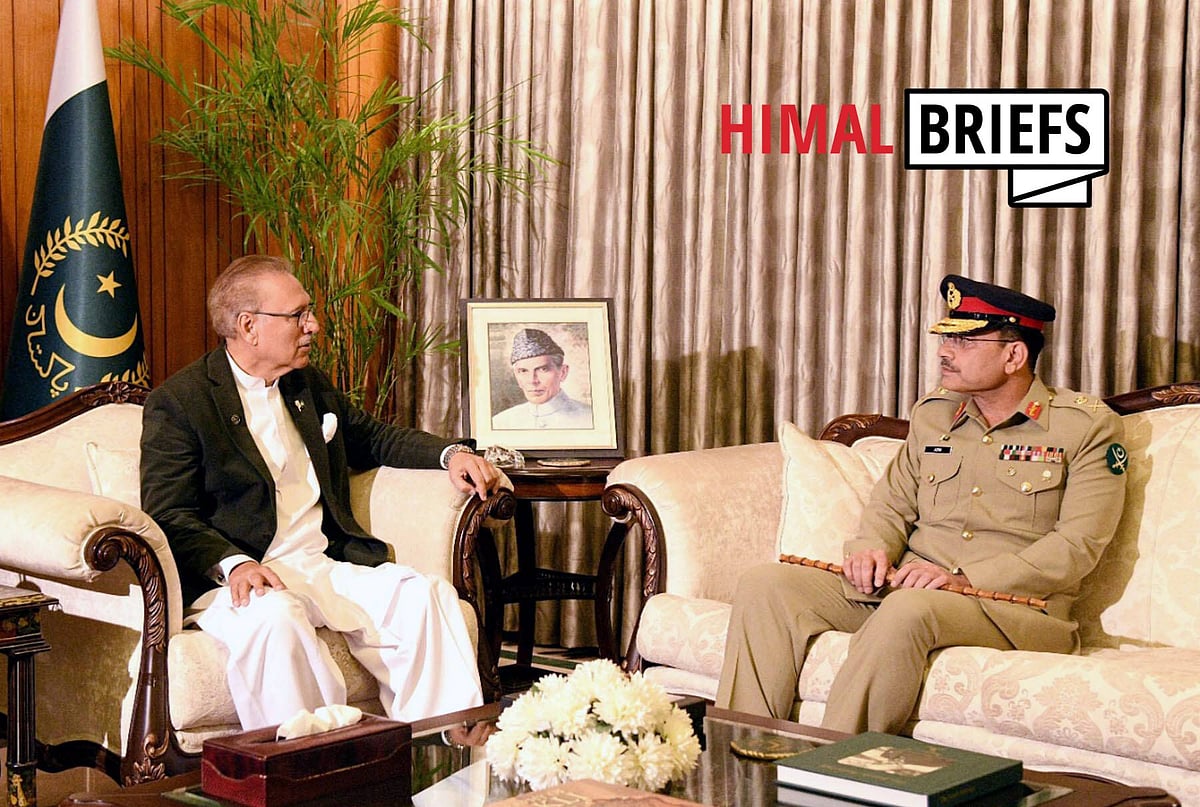
On 24 November, 2022, Pakistan's prime minister, Shehbaz Sharif, nominated Lieutenant General Syed Asim Munir as the country's 17th Chief of the Army Staff (COAS). Munir's appointment followed what can best be described as an intense intra-elite tussle involving the outgoing military chief, General Qamar Javed Bajwa, over the appointment of his successor. Sharif's incumbent coalition government defended its constitutional right to decide on the appointment. Unlike with other key appointments – such as that of the chief election commissioner, which involves consultation between the government and the opposition – Pakistan's Constitution does not provide for the opposition to be involved in the appointment of the army chief. Pakistan's mainstream media intensified this tussle with its obsessive reporting on the issue, explaining which individuals were favoured for the post by each of the major political parties and by the military itself. Equally, the frenzy gripped social media, where major stakeholders – including the political parties and the military establishment – waged a proxy war to try and secure their favoured army chief.
Why has the appointment of the COAS in Pakistan been such a contentious issue? To begin with, Pakistan has a long history of military rule, from Mohammad Ayub Khan to Pervez Musharraf. The political and strategic analyst Shuja Nawaz, in his well-researched Crossed Swords: Pakistan, Its Army and the Wars Within, shows how the military establishment has also indirectly manipulated civilian governments, even during the so-called decade of democracy (1988-1999). The military is represented by the COAS, who acts, according to a Pakistan People's Party (PPP) parliamentarian who requested anonymity, as the "ultimate guardian of the system." Therefore, the choice for the post of COAS holds immense political significance for any party, as good or bad ties with the military leader can decide the future of any civilian government.
Military creep
The 18th Amendment to the Constitution was passed, in 2010, specifically to make subversion of the Constitution an offence amounting to high treason, while simultaneously stripping the higher courts of the ability to legitimise such interventions (effectively blocking future military intervention). But even this did not end the military's involvement in politics. This remains true even though Pakistan has not seen martial law since 2008, when General Pervez Musharraf resigned as president. Several parliamentarians, such as the former senator Farhatullah Babar of the PPP, believe that the post-2010 governing system has gradually become a hybrid one that includes the military as a key player.