
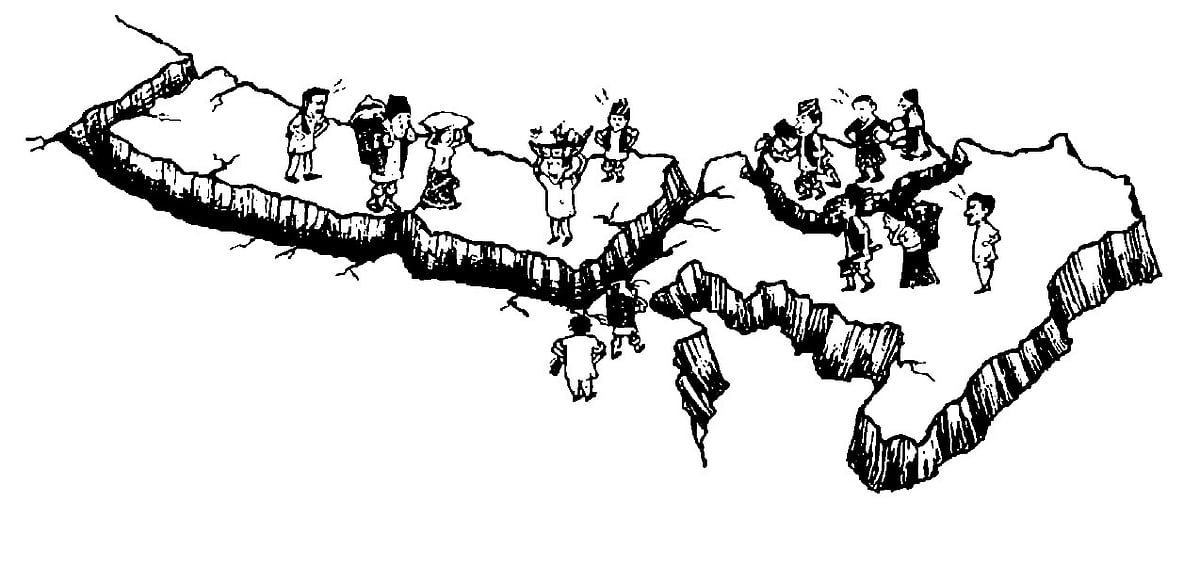
The thin stretch of land from Dehradun eastwards to Arunachal Pradesh, variously identified as the bhabar, tarai or duar, is today much in the news, particularly in the Nepal context. But just a century and a half ago, this was not known as a densely populated area. Only a few ethnic groups and stray settlers populated this land, infamous for flash floods, wild animals and, especially, malaria. Today, however, these resource-rich plains of Nepal, Bhutan and India have turned into a hotbed of dissent – an area of continued neglect and exploitation, often ignored by decision-makers, and largely circumvented by nation-building efforts. Uncovering various aspects of deprivation inevitably leads to the lost opportunities of three significant communities: the Madhesis, the Lhotshampa and what can be referred to as the nepamul bharatiya, or Indian citizens of Nepali origin.
In Nepal, it is usually claimed that those today referred to as Madhesis are the land-hungry migrants from the Indian plains who came to the Tarai after the so-called Sepoy Mutiny of 1857, purportedly with a view to clearing the area's forests and occupying its fertile agricultural lands. For their part, in India it is similarly maintained that, around the same time, Nepalis were invited by the British to develop Darjeeling and to mine copper and mint coins in Sikkim. Finally, in Bhutan the claim is that the Lhotshampa were recent illegal migrants to the country. Yet there is sufficient historical evidence to show that the ancestors of the Madhesis in the Tarai, the Nepamul in Sikkim and Darjeeling, and the Lhotshampa in Bhutan were already in these areas well before the 1814-15 Anglo-Nepali war. Indeed, not only should these groups not be called 'migrants', but some of them have good claim to be considered sons and daughters of the soil.
As a result of the 1815 Treaty of Sugauli, Nepal was forced to surrender the entire Tarai to the British, though much of this was later returned. All of the land east of the Mechi River was ceded to the East India Company, while the rulers of Nepal renounced their claims to the territories west of the Kali River. In addition, Nepal was not to "disturb" the Raja of Sikkim, with the British vested with powers of arbitration in case of differences. Soon, the East India Company carved out the buffer state of Sikkim between Nepal and Bhutan, and, under the 1817 Treaty of Titalia, the British ceded the eastern lands secured from Nepal to this new state, which was in effect a British feudatory.
Soon thereafter, the British began to develop Darjeeling, whereupon the adjoining feudatories became increasingly worried about controlling their serfs and peasants, who were suddenly attracted by the possibilities of working in this thriving hill station. By the 1860s, this turmoil resulted in two additional treaties, between the East India Company and Sikkim, and between the Company and Bhutan – the treaties of Tumlong and Sinchula, respectively. Under these, the thinly populated territory of Darjeeling was finally secured.