
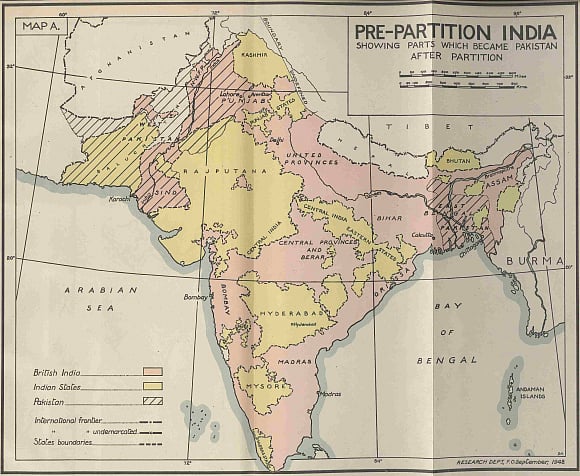
What the map cuts up, the story cuts across.
– Michel De Certeau
That myths construct nations has by now become a post-truism. In the 60 years since August 1947, most Southasians have realised, and perhaps begun to move beyond, this maxim. The Partition of the Subcontinent and the Independence of India and Pakistan inaugurated both triumph and tragedy in such callous proximity that the story of one remains incomplete – and, in fact, becomes misleading – without the mournful narration of the other.
Almost every genre of Southasian public discourse – political debates, textbooks, films, fiction, academic and popular histories – has captured the vicissitudes of the era that culminated in August 1947. Such representations and analyses have remained largely restricted to the roles of prominent personalities, the unhealthy evolution of religious communalisms, and constraints produced by political exigencies or structural factors. Of late, novel perspectives have been offered by academic historians and political scientists who have focused on the logic of the colonial administrative machinery and its impact on the process of nation-state formation, in order to explain the Partition. Undeniably, existing accounts of the Subcontinent's painful passage from a colony to a collection of postcolonial nation states are emotive, rich and controversial. However, little attention has been paid to the process through which the Subcontinent's territory was politically organised under the British rule, and the impact this may have had on the events of 1947, and since.