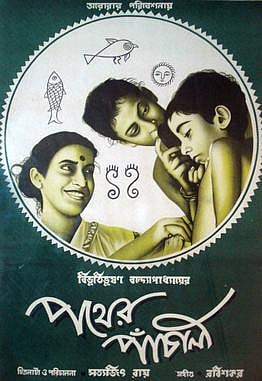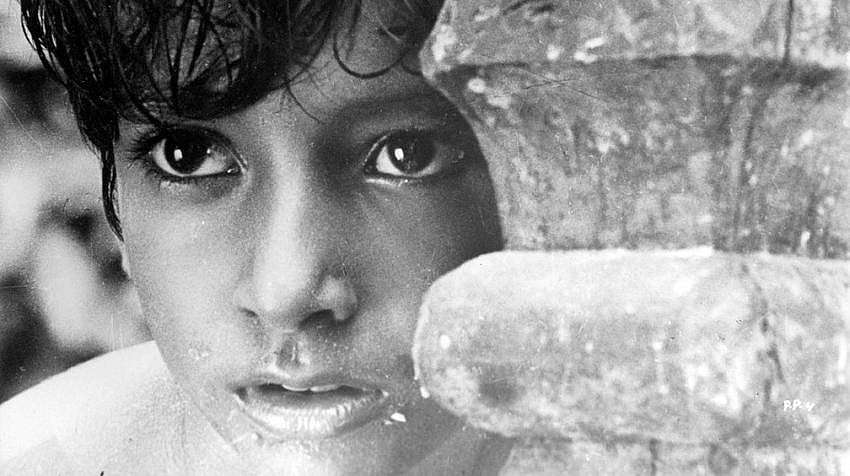
Satyajit Ray's Pather Panchali (The Song of The Little Road, 1955), was the turning point in Indian cinema. Before it, songs and villains were the two staples of Hindi commercial films of Bombay, and those in the other regional languages. If the lead characters known as the hero and the heroin felt happy, sad, perplexed or just foot-loose they burst into song. This courtesy was sometimes extended to other supporting players, usually to comment on the action of the plot. Then of course, there was the story, if it could at all be called that, hinged as it was on the principle of blame. The characters were puppets in the hands of fate and its agents usually other members of the immediate or extended family or their own social group or quite another. The narrative was usually inspired by elements from two epics, the Mahabharata and the Ramayana. In short, Indian cinema before the advent of Ray was folk-theatre in film that drew sustenance from myth, legend and religion.
There had hardly been a more auspicious film debut anywhere since Orson Welles's epoch-making first film Citizen Kane in 1941, which did him more harm than good — a masterpiece at 26 and a life in exile since 1950, resulting from specious charges of extravagance and intransigence made by Hollywood. But Ray's career graph was the exact opposite: growing appreciation and fame, a reputation for always completing a project well within a frugal budget, consistently making a reasonable profit for his producers and sometimes even more as in the case of eight of his films. Even the versatile and gifted Francois Truffaut of the French New-Wave who made as effective a first feature film as Four Hundred Blows (Les Quatre cents Coups) in 1959 as did his iconoclast colleague Jean Luc Goddard a year earlier with Breathless (A boute de soufflé), could hardly have matched the sheer maturity of Pather Panchali.
The debut film was adapted from Bibhuti Bhushan Bandopahyaya's poetic saga of Bengali rural life in the early 1900s. The sprawling novel was pruned by the fledgling script writer, its essence retained with unusual skill. Ray had written a couple of feature film scripts earlier including the very 'Hollywoodish' – his own word – adaptation of Tagore's Home and the World or Ghare-Baire which he was to direct late in his career. There were no songs in Pather Panchali or, for that matter, villains. Life with its ebbs and flows and its enduring majesty was the real hero on screen. The tragedies and the lighter moments in the lives of the members of an impoverished Brahmin family had a truthfulness rarely seen in cinema. Time and its passage, a cardinal principle of the medium, were captured with unusual fidelity. The film's Wordsworthian tone, however unintentional, struck a chord in the hearts of Western audiences particularly in England and America. At home, too, it was a success with audiences in Calcutta even before it was awarded the prize for 'The Best Human Document' at the 1956 Cannes film festival. A young master had sprung full-grown from the head of Jove.