
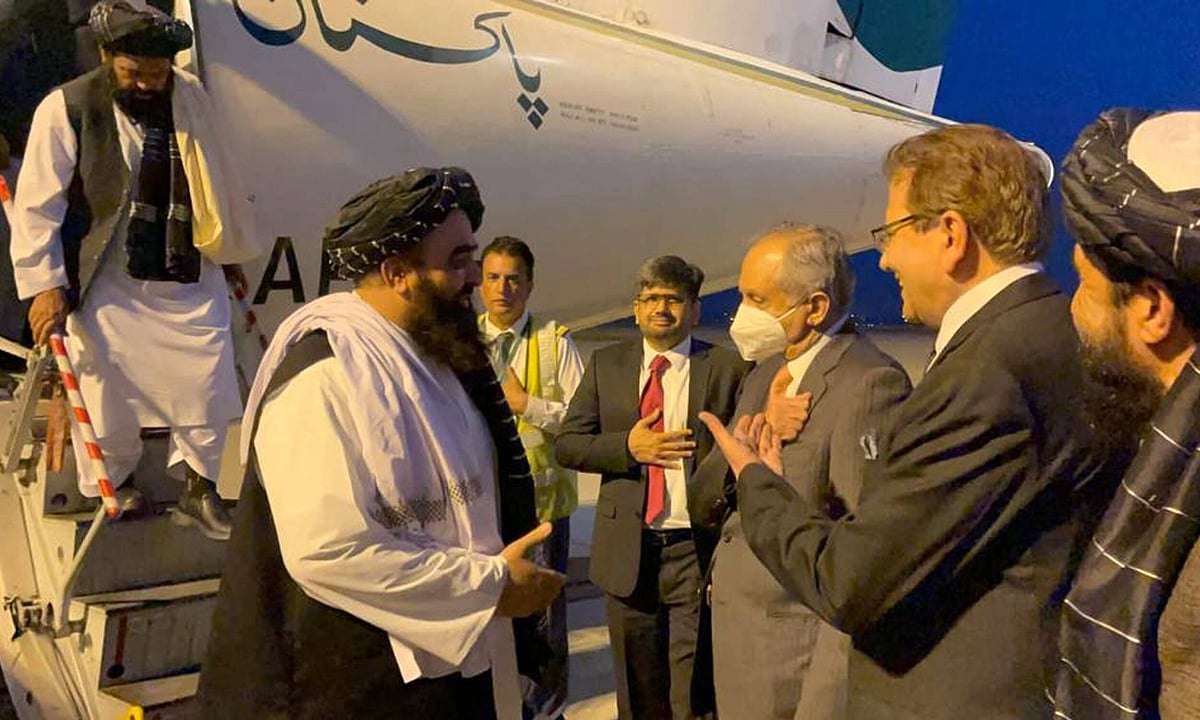
In August 2021, soon after US forces withdrew completely from Afghanistan, Imran Khan, who was then Pakistan's prime minister, felicitated the Taliban for "breaking the chains of slavery." Faiz Hammed, at the time the director general of the Inter-Services Intelligence (ISI), Pakistan's main intelligence agency, visited Kabul and told the media that "everything will be okay." He was assuring the people of Pakistan that the Taliban's victory and return to power in Afghanistan would help Pakistan curb religious and nationalist militancy, such as that arising out of the Baloch separatist movement. In November 2023, however, Pakistan's caretaker prime minister, Anwar-ul-Haq Kakar, claimed that the surge of terrorism in Pakistan after 2021 was linked to the Afghan Taliban's continued support for groups like the Tehrik-i-Taliban Pakistan (TTP).
While the Afghan Taliban denies Pakistan's claims, Kakar's statement reflects the unexpected souring of relations between the two countries. These tensions are at the heart of Pakistan's decision to deport millions of Afghans living in Pakistan since the 1980s, some of whom arrived as refugees and others who were born in Pakistan. Early this October, the Pakistan government issued an ultimatum to all undocumented foreigners to leave Pakistan by 1 November, targeting mainly Afghan migrants. This was widely seen as a tit-for-tat policy decision motivated by Islamabad's desire to put additional economic burden on Kabul due to the latter's seeming inability and unwillingness to tackle and eliminate the TTP, the Islamic State-Khorasan (IS-K) and numerous Baloch separatist outfits, all of which have had Taliban support.
The TTP has carried out several attacks in Pakistan over the last couple of years, just like the IS-K, whose highly sophisticated attacks have included one that killed 54 people in July 2023. Baloch separatist groups, active in the long-running insurgency against Pakistan's rule in Balochistan, have historically found sanctuaries inside Afghanistan. Policymakers in Pakistan seem to believe that Afghanistan has become more welcoming to anti-Pakistan elements and squarely blame the Taliban for this.
One official from Pakistan's interior ministry told me, on condition of anonymity, "All Afghanistan-based groups are targeting Pakistan only. The IS-K attacked China and Russia once only in Afghanistan. But Pakistan has been attacked both inside Afghanistan and within its own borders since the US withdrawal." The official was referring to attacks inside Pakistan as well as on Pakistan's embassy in Kabul in December 2022, for which the IS-K took responsibility. The militant group also claimed responsibility for a suicide bombing at the ministry of foreign affairs in Kabul in January 2023, on a day when a Chinese delegation was to hold talks with the Taliban in the area. Earlier, in September 2022, it had carried out a suicide attack on the Russian embassy in Kabul, killing two Russian diplomats. The official said that "this has become possible because, and we have reasons to believe, the Afghan networks based in Pakistan" – meaning Afghan refugees – "act as channels for terror groups to infiltrate and carry out attacks … Their agenda is to make the border irrelevant and control Pakistani territory."