
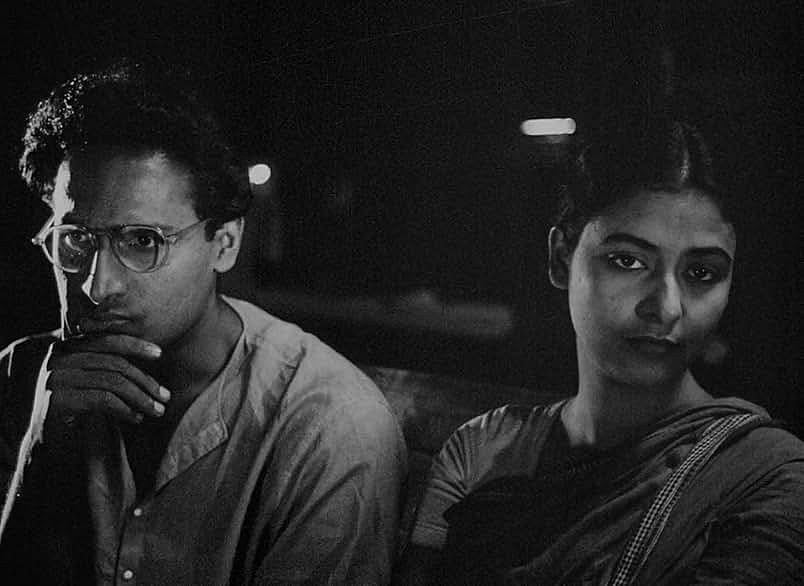
An artiste, even in this age of mindless greed and hurry, captures the public imagination, if only for a moment or two, should he or she answer to type, that is, of being a romantic idealist. Ritwik Ghatak, the Bengali filmmaker and short story writer, was such an individual and an alcoholic to boot like the Urdu poet of romance and revolution, Majaz Lucknawi; or Sailoz Mookerjea, the painter whose soul made a daily creative journey across continents—from the French countryside of the Impressionists to the verdant green Bengal of his childhood and youth, and austere, dusty Delhi where he finally settled down. Like them, Ghatak died young – in his fifty-first year, on 6 February 1976. His send-off was perfunctory, like the ones accorded to Majaz and Sailoz, and it took a long time for a larger public to gauge the worth of the three of them. The reason for this neglect was probably lack of access to their work.
In retrospect, Ghatak stands a better chance of being in the public gaze because of the nature of his medium—cinema—which has a far greater reach than either poetry or painting. He had problems finding finance for his films because of his inability to suffer fools, especially in the film world, and this compounded with a talent for insulting hypocrites, including would-be producers, when drunk, made his own life and that of his family completely miserable.
He forgot that he lived in a country that was simultaneously half-feudal and half-capitalist and was still emerging from the shadow of colonialism. Directness and honesty in private and professional life were qualities lauded in the abstract but viewed with suspicion, even fear, in the real world. In Ghatak's case it was inevitable that alienation and unemployment would lead to alcoholism, bankruptcy and an early death. His worldly failure was somehow seen as the touchstone of 'artistic worth' by a certain section of the Indian elite and he was claimed by them as one of their own some ten years ago. This is all the more ironic for they have neither knowledge nor intuition of the language or the culture that made a genius like him possible.
Like many communists of his time, Ghatak came from the feudal class but from its educated minority that had access to Sanskrit, Bengali, Persian, English, the literature and philosophy of Europe, including the writings of Sigmund Freud and Karl Marx, and the heritage of Hindustani and Western classical music. To this formidable intellectual baggage he added, in later years of artistic maturity, the ideas of the psychoanalyst, CG Jung, the explorations in cultural anthropology, including the Great Mother image in Joseph Campbell's prose, derived from Erich Neuemann's The Great Mother, and the vast repertoire of folklore and folk music of India, and the two Bengals—East and West.